
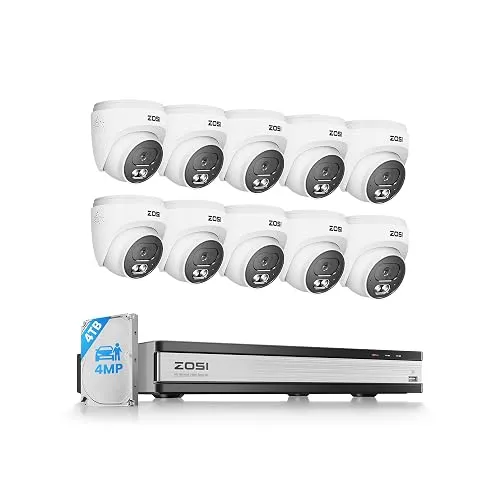
PoE dome kit
C220 16CH 4K NVR, 10×4MP Domes, 4TB
C220 kit with a 16-channel 4K NVR, ten 4MP audio PoE domes and a 4TB drive. 100ft night vision, two-way talk and person and vehicle alerts, with six channels left free.
PoE dome kit
C220 kit with a 16-channel 4K NVR, ten 4MP audio PoE domes and a 4TB drive. 100ft night vision, two-way talk and person and vehicle alerts, with six channels left free.
Most home camera systems are planned backwards. People buy a kit, count the cameras in the box, and then look for places to put them. A better way is to walk the property first, decide what each spot actually needs to show you, and only then choose camera types and a recorder. That order also tells you how many cameras you need, which matters more than any single spec on the box.
This guide covers that walk-around step by step. It uses the pixel-density guidance in the international video-surveillance standard IEC 62676-4 to set a detail target for each zone, then goes around a typical house from the front door to the back fence, and finishes with cable, privacy and camera-count planning. Where a ZOSI camera type suits a zone, the guide names it.
A camera that shows someone crossing the lawn and a camera that shows who it was are doing two different jobs. IEC 62676-4:2014 turns this into four levels, often shortened to DORI. Axis Communications' white paper on the standard gives these figures, based on an average face width of about 16 cm:
Swipe sideways to see the whole table →
| Level | What you can tell | Pixel density at the target |
|---|---|---|
| Detection | Whether anyone is there at all | 25 px/m (about 8 px/ft) |
| Observation | How many people, and details such as distinctive clothing | 63 px/m (about 20 px/ft) |
| Recognition | Whether this is someone you've seen before | 125 px/m (about 40 px/ft) |
| Identification | Who the person is | 250 px/m (about 80 px/ft) |
Pixel density means how many horizontal pixels cover each meter of the scene at the spot you care about. You can estimate it with simple division: image width in pixels ÷ scene width in meters at that spot.
Two examples show why this matters more than the resolution figure alone:
In short, faces are captured close up, and wide views are for overview. The Axis paper also points out that these numbers are rules of thumb. Lighting direction, lens quality and compression all affect the result, and someone not facing the camera needs more margin. Plan for more pixels than the minimum wherever faces matter.
Walk every approach to the house and note three things for each spot: what level of detail you want, how wide the view has to be, and whether you can run a cable to a mount there.
This is where you want faces, and it's also the easiest place to get them. Visitors stop, face the door, and stand within a few meters of it. A camera mounted near the door and angled down covers a narrow scene, which puts pixel density far above the identification line.
Fixed domes suit this spot: the view never moves, and the housing sits neatly under an eave or porch ceiling. The ZOSI C220 family is built around fixed audio PoE cameras, and its larger kits leave room to cover several doors. The C220 16CH 4K NVR, 10×4MP Domes, 4TB pairs a 16-channel 4K NVR with ten 4MP audio PoE domes and a 4TB drive. ZOSI's C220 pages list human detection with app and email alerts, two-way audio, H.265+ recording, and remote viewing through the ZOSI app or PC client. With 16 channels and 10 cameras, six channels are free for later add-ons.
Driveways are wide and deep, so one fixed camera at the house usually delivers observation-level detail across most of the scene. You can handle that in two ways:
The second approach is what the ZOSI C296 line is built around. The C296 8CH 4K PoE, 6×5MP Pan-Tilt, 2TB pairs an 8-channel 4K PoE NVR with six 5MP pan-tilt audio cameras and a 2TB drive. ZOSI's C296 pages describe human auto-tracking, two-way audio, and spotlight and siren deterrence. Pan-tilt housings need clearance to turn, so keep them away from walls and soffit edges. Don't assume optical zoom. ZOSI's pan-tilt pages mention digital zoom in some places, so check the version you buy. For bigger lots, the C290 16CH 4K PoE, 16×8MP Pan-Tilt, 4TB scales the same idea up. If you already have a compatible recorder, the C290 4K 8MP PoE PT (2-Pack) adds two pan-tilt cameras.
Side passages are long and narrow, so a camera at one end looking down the length covers the whole path with a small scene width near the gate. Bullet cameras are the usual fit: they're easy to aim along a straight line, though the housing is more visible than a dome. Aim the camera at the gate or pinch point where someone must pass, not at the empty middle of the path, so the useful pixels land where the person will be.
The C186 16CH 4K NVR, 8×5MP Bullets, 4TB is a full ZOSI kit: a 16-channel 4K NVR, eight 5MP audio PoE bullets and a 4TB drive, which leaves eight channels open. For a smaller house, the C186 8CH 4K NVR, 4×5MP Bullets, 2TB is the four-camera version. The C186 5MP PoE Audio Bullet is sold on its own for filling gaps later. It works with a ZOSI PoE NVR and takes one free port.
Treat the back door like the front door, with a close camera aimed for faces. Treat the yard like the driveway, with a wide view for detection and observation.
Indoor cameras don't need weatherproof housings or Ethernet to every room. ZOSI's C518 4K 8MP Indoor 360° PT WiFi is an indoor pan-tilt camera for rooms. The C680 2K 3MP WiFi Window Cam (4-Pack) mounts on a window with no drilling. ZOSI notes that glass reflections and night performance vary, so test the view first. Neither replaces an outdoor camera.
PoE (Power over Ethernet) carries power and video to each camera over one network cable, which is why the ZOSI kits above are wired systems. The limit to plan around is distance. Per a NETGEAR engineering note on the IEEE PoE standards (802.3af, 802.3at and 802.3bt), the maximum Ethernet run is 100 meters (328 ft), including patch cables. Cat 5e or Cat 6 is recommended. Beyond that, you need a switch or extender along the way.
In practice:
If a spot truly can't be cabled, such as a detached shed or a far gate, the C291 4×4MP Solar Wireless PT runs on battery and solar. It records differently from an always-on PoE recorder, and the solar panel needs good sun.
Many ZOSI cameras include microphones, so placement is also a privacy question.
This is general information, not legal advice.
Add up the spots from your walk-around. A typical detached house might list the front door, driveway, both side gates, the back door and the back yard. That's six before any indoor cameras. Then match the count to a recorder with room to spare. An 8-channel NVR with six cameras leaves two channels free. A 16-channel NVR with eight or ten leaves room for the gaps you'll only notice after living with the system. How to Choose ZOSI PoE Camera Systems & Security Kits explains how to read channels, cameras in the box and drive size separately. Expansion cameras such as the 5MP 3K Add-on PoE Dome fill free channels later.
Swipe sideways to see the whole table →
| Zone | Detail target | Typical camera | ZOSI option to look at |
|---|---|---|---|
| Front door / porch | Identification | Fixed dome, close and angled down | C220 fixed domes |
| Driveway / open yard | Observation, recognition at the pinch point | Pan-tilt, or wide fixed plus a tight fixed camera | C296 or C290 pan-tilt |
| Side gate / fence line | Recognition at the gate | Bullet aimed down the length | C186 bullets |
| Back door | Identification | Fixed dome | C220 or add-on dome |
| Back yard | Detection, observation | Pan-tilt or wide fixed | C296 pan-tilt |
| No cable possible | Detection, observation | Solar wireless | C291 |
| Indoors / windows | Varies | WiFi indoor | C518, C680 |
How high should I mount cameras? High enough to be out of easy reach, but not so high that a door camera sees mostly the tops of heads. The Axis paper notes that people not facing the camera need extra pixel margin, so keep face cameras close and only slightly angled down. Wide overview cameras can go higher.
Is more megapixels always better? Only if the extra pixels land on the spot you care about. As the examples above show, halving the width of the view doubles the pixel density. Moving a camera closer often does more than buying a higher resolution.
Do I need a pan-tilt camera? Not for doors or narrow paths. Pan-tilt cameras make sense for wide open areas where one mount would otherwise need several fixed cameras.
Can I mix camera types on one recorder? ZOSI sells add-on domes, bullets and pan-tilt cameras for compatible NVRs. Check free channels, PoE capacity and the compatibility notes on the specific product page first.
For a full overview of the range, start with the ZOSI review. If you're deciding between fixed domes and pan-tilt, C220 Fixed Domes vs C296 Pan-Tilt compares them directly. You can also browse ZOSI PoE Camera Kits, ZOSI NVR Security Kits, ZOSI Bullet Camera Systems, ZOSI Bullet Cameras & Kits and ZOSI Dome & Specialty Cameras. Once your placement worksheet is filled in, match it to the ZOSI security camera systems by camera count and style. If running cable is the sticking point, About ZOSI Security separates the PoE kits from the WiFi and solar models.
The short version: faces at the doors, overview across the open ground, cameras aimed along the paths, and a recorder sized for the plan with spare channels.